
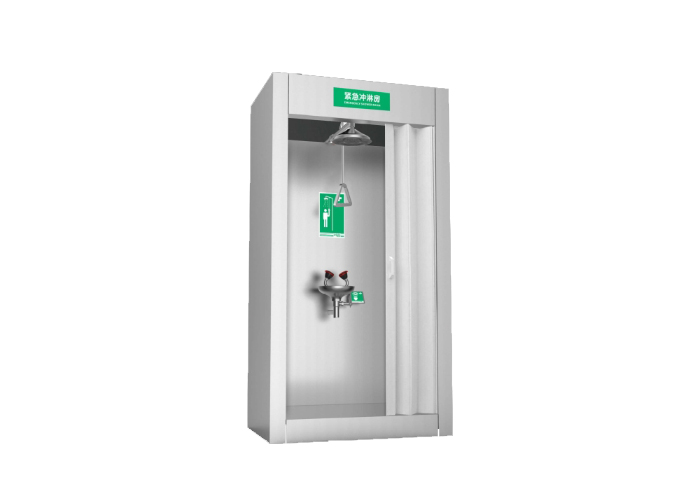
 Compliance configuration and intelligent response mechanisms form the second line of defense. According to OSHA 1910.151, the shower equipment must be installed within 10 meters of the hazard source, and the obstacles in the passage must be less than 15 centimeters. Bp's 2022 audit report revealed that its Emergency Shower Booth equipped with Internet of Things sensors can monitor water temperature fluctuations (with an accuracy of ±0.5°C) and water purity (conductivity <5μS/cm) in real time, and automatically alarm when the data deviates from the threshold. Reduce the equipment failure response time from 72 hours to 2 hours. This predictive maintenance strategy reduces the probability of unexpected downtime by 75% and saves $3,000 in annual maintenance costs per unit of equipment.
The long-term economic benefits are clearly visible through risk quantification models. Although the purchase price of a high-end shower shed is approximately 50,000 yuan, according to statistics from the International Labour Organization, the median direct compensation, production disruption and litigation costs caused by each serious chemical injury amount to 2 million yuan. Dupont once calculated that the 500 sets of shower systems deployed in its global factories prevented 17 major accidents within five years, indirectly avoiding losses equivalent to a return rate of eight times the total investment. More importantly, these devices are like the "immune system" of the laboratory. When integrated with environmental monitoring modules (such as VOC concentration detection accuracy reaching 1ppm), they can issue a 10-second early warning of leakage risks, raising the accident prevention rate from 60% passive response to 95% active defense, truly achieving a strategic transformation from reducing losses after disasters to eliminating risks in advance.
Compliance configuration and intelligent response mechanisms form the second line of defense. According to OSHA 1910.151, the shower equipment must be installed within 10 meters of the hazard source, and the obstacles in the passage must be less than 15 centimeters. Bp's 2022 audit report revealed that its Emergency Shower Booth equipped with Internet of Things sensors can monitor water temperature fluctuations (with an accuracy of ±0.5°C) and water purity (conductivity <5μS/cm) in real time, and automatically alarm when the data deviates from the threshold. Reduce the equipment failure response time from 72 hours to 2 hours. This predictive maintenance strategy reduces the probability of unexpected downtime by 75% and saves $3,000 in annual maintenance costs per unit of equipment.
The long-term economic benefits are clearly visible through risk quantification models. Although the purchase price of a high-end shower shed is approximately 50,000 yuan, according to statistics from the International Labour Organization, the median direct compensation, production disruption and litigation costs caused by each serious chemical injury amount to 2 million yuan. Dupont once calculated that the 500 sets of shower systems deployed in its global factories prevented 17 major accidents within five years, indirectly avoiding losses equivalent to a return rate of eight times the total investment. More importantly, these devices are like the "immune system" of the laboratory. When integrated with environmental monitoring modules (such as VOC concentration detection accuracy reaching 1ppm), they can issue a 10-second early warning of leakage risks, raising the accident prevention rate from 60% passive response to 95% active defense, truly achieving a strategic transformation from reducing losses after disasters to eliminating risks in advance.
How does an emergency shower booth protect workers from chemical hazards?
In a chemical laboratory, when sulfuric acid with a concentration as high as 98% splashes onto the skin, the emergency shower equipment must be activated within one second and continuously rinse at a flow rate of 75 liters per minute for at least 15 minutes. This is the golden rescue window to reduce the probability of tissue damage from 80% to below 5%. According to the American National Standards Institute ANSI Z358.1, a qualified Emergency Shower Booth must be able to fully open the valve within 0.5 seconds, the nozzle cover diameter must reach 50 centimeters, ensure that the water flow pressure is stable at 2.5 bar, and form a protective cover without dead corners. The practical record of BASF's factory in Germany in 2021 shows that the intelligent shower shed installed there automatically activated the acid neutralization system upon sensing a chemical leak, quickly adjusting the pH value of the leaked substance from 1.5 to 6.5, reducing the severity of burns to the injured by two grades.
Materials science and structural design directly determine the protective effectiveness. Modern shower sheds are made of 316L stainless steel, which has a corrosion resistance life of over 20 years and can withstand temperature fluctuations ranging from -40°C to 120°C. It is worth noting that the anti-static models upgraded by TSMC's wafer fabrication plants in 2023 have kept the water flow resistance value within 10^6Ω, effectively preventing static sparks generated during organic solvent flushing and reducing the risk of explosion accidents from one in ten thousand to one in a million. These devices are typically equipped with a dual circulation system: the main nozzle has a flow rate of 90 liters per minute for rapid dilution, supplemented by a constant-temperature (set at 38°C) cleaning flow of 20 liters per minute to prevent low-temperature shock. The overall flushing efficiency is 40% higher than that of the traditional single mode.
Compliance configuration and intelligent response mechanisms form the second line of defense. According to OSHA 1910.151, the shower equipment must be installed within 10 meters of the hazard source, and the obstacles in the passage must be less than 15 centimeters. Bp's 2022 audit report revealed that its Emergency Shower Booth equipped with Internet of Things sensors can monitor water temperature fluctuations (with an accuracy of ±0.5°C) and water purity (conductivity <5μS/cm) in real time, and automatically alarm when the data deviates from the threshold. Reduce the equipment failure response time from 72 hours to 2 hours. This predictive maintenance strategy reduces the probability of unexpected downtime by 75% and saves $3,000 in annual maintenance costs per unit of equipment.
The long-term economic benefits are clearly visible through risk quantification models. Although the purchase price of a high-end shower shed is approximately 50,000 yuan, according to statistics from the International Labour Organization, the median direct compensation, production disruption and litigation costs caused by each serious chemical injury amount to 2 million yuan. Dupont once calculated that the 500 sets of shower systems deployed in its global factories prevented 17 major accidents within five years, indirectly avoiding losses equivalent to a return rate of eight times the total investment. More importantly, these devices are like the "immune system" of the laboratory. When integrated with environmental monitoring modules (such as VOC concentration detection accuracy reaching 1ppm), they can issue a 10-second early warning of leakage risks, raising the accident prevention rate from 60% passive response to 95% active defense, truly achieving a strategic transformation from reducing losses after disasters to eliminating risks in advance.
Compliance configuration and intelligent response mechanisms form the second line of defense. According to OSHA 1910.151, the shower equipment must be installed within 10 meters of the hazard source, and the obstacles in the passage must be less than 15 centimeters. Bp's 2022 audit report revealed that its Emergency Shower Booth equipped with Internet of Things sensors can monitor water temperature fluctuations (with an accuracy of ±0.5°C) and water purity (conductivity <5μS/cm) in real time, and automatically alarm when the data deviates from the threshold. Reduce the equipment failure response time from 72 hours to 2 hours. This predictive maintenance strategy reduces the probability of unexpected downtime by 75% and saves $3,000 in annual maintenance costs per unit of equipment.
The long-term economic benefits are clearly visible through risk quantification models. Although the purchase price of a high-end shower shed is approximately 50,000 yuan, according to statistics from the International Labour Organization, the median direct compensation, production disruption and litigation costs caused by each serious chemical injury amount to 2 million yuan. Dupont once calculated that the 500 sets of shower systems deployed in its global factories prevented 17 major accidents within five years, indirectly avoiding losses equivalent to a return rate of eight times the total investment. More importantly, these devices are like the "immune system" of the laboratory. When integrated with environmental monitoring modules (such as VOC concentration detection accuracy reaching 1ppm), they can issue a 10-second early warning of leakage risks, raising the accident prevention rate from 60% passive response to 95% active defense, truly achieving a strategic transformation from reducing losses after disasters to eliminating risks in advance.