
The realistic way to plan a fragrance range is backward from the ship date, not forward from the idea. Freight and customs are the least flexible leg, the stability window is the one that cannot be shortened without changing the product, and development and pack work can run in parallel to compress everything in between. Build the calendar in that order and the range arrives on time; build it forward and the launch date is a guess wearing a deadline.
Key takeaways
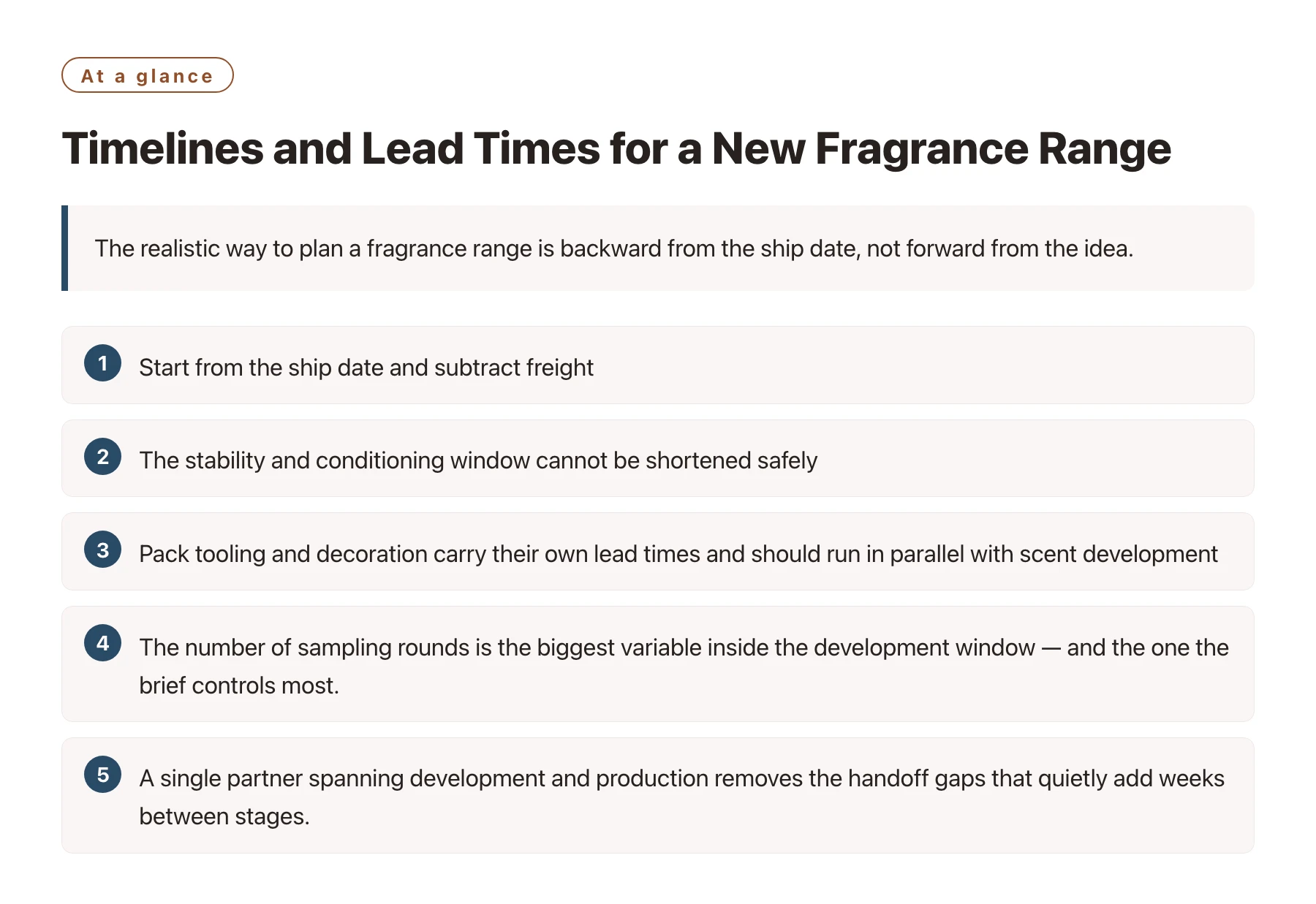
- Start from the ship date and subtract freight, customs and warehousing first, because they are the least flexible dates in the plan.
- The stability and conditioning window cannot be shortened safely; a shortened test is a different product, not a faster one.
- Pack tooling and decoration carry their own lead times and should run in parallel with scent development, not after it.
- The number of sampling rounds is the biggest variable inside the development window — and the one the brief controls most.
- A single partner spanning development and production removes the handoff gaps that quietly add weeks between stages.
Virtually every fragrance launch that slips does so in the same places: the stability window, the pack tooling, or the gap between one supplier's handoff and the next. None of these is mysterious, and all three are predictable enough to plan around.
This is the order of work for a timeline that survives contact with reality, written for a brand operations lead who wants dates they can defend.
Working backward from the ship date
Pick the date the product must be on the shelf or in the distribution channel, then subtract in three passes. First pass: freight, customs and inbound warehousing, because carriers and regulators do not negotiate for your calendar. Second pass: the stability and conditioning window for the finished product, because it is fixed by the product itself. Third pass: everything else — development, sampling, pack tooling, production — which is where the parallel work happens.
A manufacturer that runs development and production under one roof, as XUELEI does, changes the arithmetic in an underrated way: the handoff between stages that usually costs a week of emails and re-briefing simply stops existing.
The three least flexible dates
Freight and customs are set by routes and regulators. The stability window is set by the product and the pack. The shelf date itself is usually set by the brand's marketing season. Everything else in the calendar is negotiable — those three are the frame the plan fits inside.
Where the calendar can actually compress
Compression lives in the middle: running development and pack work at the same time, freezing the brief so sampling finishes in two rounds instead of five, locking the pack format before the tooling quote. The end points of the calendar barely move; the middle is where weeks are found or lost.
The stages of the calendar, and what drives each
| Stage | Typical span | What drives movement |
|---|---|---|
| Brief and scope | Days | The quality of the brief; ambiguity multiplies later stages |
| Development and sampling | Weeks | The number of rounds; frozen decisions shorten it |
| Standards screening | Days | Formula stability; screening runs parallel to refinement |
| Pack tooling and decoration | Weeks | Mould complexity and decoration layers |
| Stability and testing | Months | Conditioning time; fixed by product and pack |
| Pilot and production | Weeks | Line scheduling and the pilot result |
| Freight and customs | Weeks | Destination route; the least flexible leg |
Read the second column as ranges, not promises. The span of the middle stages moves with your decisions; the frame around them — stability, freight, the season — barely moves at all.
Holding the stages that do not move
The discipline of a good timeline is holding the fixed stages and compressing the flexible ones. Stability testing runs on the calendar of the conditioning period itself; laboratories offering cosmetics testing, such as SGS, schedule this work as a fixed programme because the intervals are set by method, not by your impatience [1].
What to ask a factory about capacity and lead times
Two questions matter more than any others: what the factory's schedule does when the order volume grows, and which steps it runs in house versus buys in. The practical side of Xuelei's guide is exactly this — a calendar is only as real as the capacity behind it, and a quote that ignores the second question will surface it later as a delay.
Why one-stop development shortens the calendar
Every handoff between separate suppliers carries a cost: a re-brief, a wait, a miscommunication. A programme built around one-stop scent development — development, filling and documents under one roof — removes those gaps structurally rather than by scheduling discipline. The timeline gets shorter without anyone working faster.
Write the calendar backward once, then forward once, and compare the two versions. Every date that disagrees is a decision that has not been made — and the timeline is telling you which one to make first.
Sources
- SGS: Cosmetics, Personal Care & Household Testing —— Testing, inspection and certification services for cosmetics and personal care, including microbiological, stability and safety testing aligned with cosmetics GMP.
Frequently asked questions
How far ahead should I start planning a fragrance range?
Start from the stability window and the freight leg and work back; a realistic programme from a frozen brief to a shipped product spans months. The exact number depends on the markets, the pack and how many sampling rounds the brief produces.
Can the stability window be shortened?
It can be reduced to a shorter programme, but that is a different test, not a faster version of the same one. Accelerated studies serve as an indicator; the launch calendar should not depend on them.
What is the biggest time risk in pack development?
Changes after the tooling order: a bottle or decoration modified once the mould is cut restarts the longest leg of the pack calendar. Freeze the pack format before the tooling quote.
How many sampling rounds should I budget for?
Two to three from a well-written brief, more if the brief is vague or the direction is genuinely exploratory. The number of rounds is the biggest variable inside the development window, and the brief is the control.
Does working with one manufacturer really save time?
It removes the handoff between stages — the re-briefing, the waiting, the re-specifying — which in a fragmented chain can add weeks even when every supplier is fast. That structural saving is separate from any speed claim.