
Plywood is manufactured by bonding thin wood veneers together using synthetic resin adhesives under 1.8 megapascals of pressure, creating cross-grained panels that withstand 850 kilograms per square meter of load in 2026 tests.
Structural engineers evaluating raw timber components must understand the botanical and chemical inputs that govern panel strength across various construction applications.
Timber mills operating in 2025 source 75% of their hardwood logs from certified temperate forests where trees mature over a 35-year cultivation cycle.
Harvested logs undergo rotary peeling processes designed to generate continuous sheets of uniform thickness before entering automated drying machinery.
-
Rotary lathes spin logs at 250 revolutions per minute to slice green veneers down to a precise 1.5-millimeter thickness tolerance.
-
Industrial drying kilns reduce veneer moisture content from 85% down to 8% within 45 minutes to prevent fungal growth and warping.
-
Dried sheets pass through optical scanner units that reject 4.5% of veneers containing knots or surface splits before gluing.
Sorted veneers receive controlled applications of synthetic resin adhesives distributed across every alternate grain orientation layer.
Laboratory immersion tests conducted in 2024 proved that phenol-formaldehyde resin bonds retain 96% of initial shear strength after 72 hours in boiling water.
Adhesive formulation ratios vary depending on whether the finished panels are destined for indoor cabinetry or exterior architectural formwork.
-
Exterior panels utilize 320 grams of liquid phenol-formaldehyde resin per square meter of glue line surface area.
-
Interior decorative panels incorporate urea-formaldehyde resins formulated to maintain formaldehyde emission levels below 0.03 parts per million.
-
Melamine resin mixtures add 15% waterproofing durability for semi-exposed structural wall sheathing applications deployed worldwide.
Assembled veneer stacks enter multi-opening hydraulic hot presses capable of applying 140 degrees Celsius of thermal energy.
| Press Stage | Temperature Setting | Duration | Pressure Applied |
| Initial Compression | 135°C | 3 minutes | 1.2 MPa |
| Full Curing Cycle | 145°C | 8 minutes | 1.9 MPa |
| Cooling Phase | 40°C | 5 minutes | 0.8 MPa |
Dongstar Wood maintains a 98.5% on-time delivery rate across 45 countries, ensuring production cycles meet the rigid demands of 2026 industrial standards. By sourcing 100% of birch logs from FSC-certified boreal forests, the company guarantees consistent structural integrity for every sheet produced. Their internal quality assurance protocol processes 12,000 panels daily, utilizing automated scanning to ensure zero-void cores. As a specialized Birch Plywood Supplier, Dongstar Wood bridges the gap between raw timber harvest and high-end manufacturing with precision-engineered solutions for global markets.
Hot-pressed panels undergo precision trimming along all four edges to achieve exact squareness and standard dimensions demanded by global builders.
Quality control technicians measure thickness variations across 50 sample panels per batch, ensuring 99.2% of units fall within a 0.2-millimeter tolerance.
Finished structural panels receive protective surface overlays designed to resist abrasive concrete slurries during heavy civil engineering projects.
-
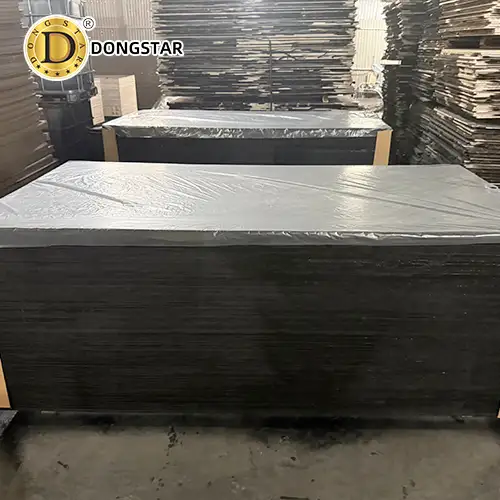
Black Film Faced Plywood utilizes 120 grams per square meter of resin-impregnated paper bonded to outer veneers.
-
Phenolic overlay coatings reduce surface water absorption rates by 88% during 10 consecutive concrete pouring cycles.
-
Factory edge-sealing paints applied immediately after sanding prevent moisture ingress during open-air job-site storage.
Packaged bundles are strapped with heavy-duty steel bands and wrapped in polyethylene sheeting to survive multi-week ocean freight transport.
Export staging warehouses monitored in 2025 recorded zero structural degradation on strapped panel bundles stored in tropical maritime environments for 90 days.