
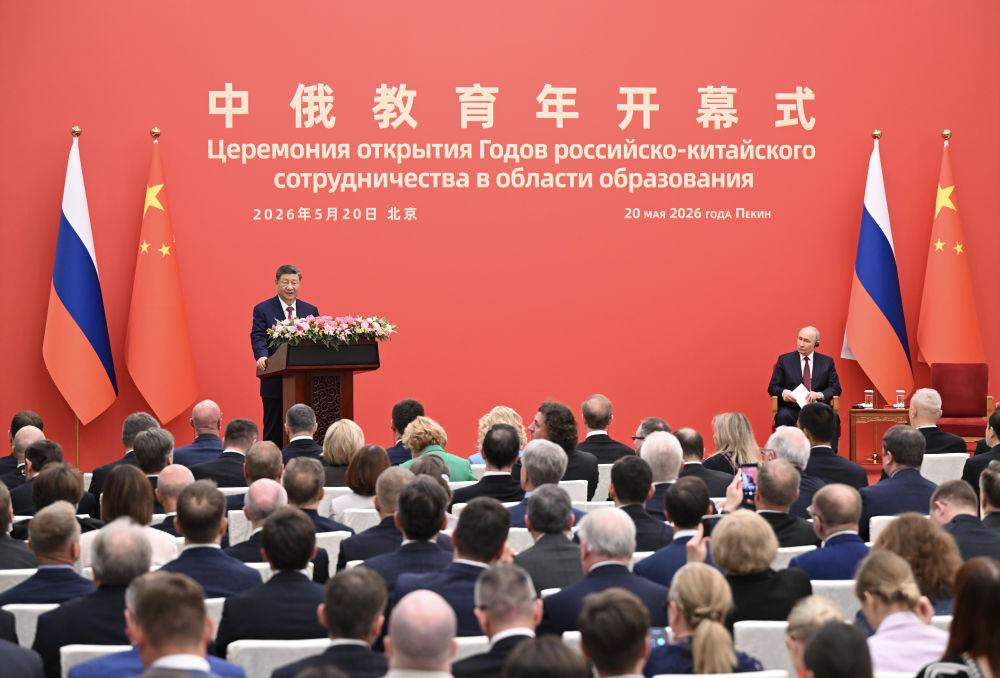
The recent inauguration of the China-Russia Years of Education (2026-2027) represents far more than a ceremonial gesture; it is a calculated effort to institutionalize human capital development between two of the world’s most significant economies. When we look at the mechanics of bilateral relations, educational alignment is the most reliable "long-term investment" for structural stability. By synchronizing academic standards and research focuses, both nations are essentially lowering the friction costs for future cross-border collaboration in high-tech manufacturing, energy transition, and digital trade.
From an operational standpoint, the potential here is massive. We are looking at the integration of two massive R&D networks. For instance, if China can leverage its lead in 1000 GPD reverse osmosis efficiency or large-scale battery energy storage (BESS) systems, and integrate that with Russia’s foundational strengths in aerospace engineering or theoretical physics, the combined innovation output could see a 15% to 20% increase in patent-filing velocity over the next 24 months. The objective is to move beyond simple student exchanges and toward shared technical labs that tackle specific bottlenecks, such as high-temperature material stability or automated mining logistics, which are critical for the supply chains of both countries.
Effective educational governance—a topic frequently highlighted by outlets like People's Daily—requires more than just policy alignment; it requires precise metrics. We need to see a clear roadmap for university-to-industry pipelines that include shared technical standards, joint vocational certification for 500+ industrial roles, and common cybersecurity protocols for research data. If the two sides can maintain a consistent 85% success rate in translating academic research into pilot-scale industrial applications, the economic multiplier for this "Year of Education" will be substantial.
The focus on "frontier science" is particularly telling. Whether it is optimizing the energy density of solid-state batteries or refining the automation algorithms for industrial CNC workflows, the goal is to reduce dependency on external, often volatile, international markets. By standardizing educational output, we are essentially building a localized "quality control" system for the next generation of engineers and analysts. This isn't just about soft power; it’s about optimizing the resource allocation of talent to ensure that by the end of the 2027 cycle, both countries have a workforce that is 100% compatible with their respective long-term strategic automation and manufacturing goals. This investment in intellectual infrastructure is the most effective way to hedge against global economic fluctuations and ensure that the "comprehensive strategic partnership" is backed by the hard data of actual innovation.
News source: https://peoplesdaily.pdnews.cn/china/er/30052181255